

There was a time when a CEO talking about the singularity would bring the priest and the doctor running over the fields. It feels a very long time ago. Here's some of a letter sent this week by the leaders of Stripe to its locked-in shareholders.
It’s a fuzzy and perhaps already overworked term, but we decided that January 1st marked the beginning of the singularity, and we have since been operating on that basis. The singularity is often invoked alongside millenarian forecasts, but, in our case, we simply saw a large inflection in long-run trends (for example, a huge increase in the rate of new firm creation), and we decided that we ought to take the phase change seriously.
What's going on here? The breezy, gee-whizz tone. The wooly notions stated with axiomatic certainty. Every sentence carries the dead weight of AI generation — though honestly, it's not clear that an algorithm was involved in the composition. Where to draw the line on what's artificial is no longer obvious. There's been a melding of minds. We look from tech-bro to chatbot, and from chatbot to tech-bro, but already it is impossible to say which is which.
Stripe does internet payments. It’s like PayPal but slightly better because its transactions usually involve one fewer click. Set up in 2010 using money from PayPal mafia kingpins Peter Thiel and Elon Musk, Stripe was valued at $159bn in the last funding round.
Staying private into its teens has let Stripe cosplay as a plucky start-up rather than an incumbent. A sense of maturity is probably not lost on management, however, who’ll know that PayPal was only 12 years old by the time they came along. There’s pressure to build a competitive moat around a business whose USP was one fewer click.
Stripe’s big plan is to close the generational loop by buying PayPal for $53bn. In the meantime, this week, it paid a reported $7bn-plus mostly in stock for OpenRouter, a kind of supermarket for AI models.
What Stripe chooses to do really is none of our business. A publicly owned company might have been expected to explain all the ways in which its ownership of a directory for website-building adds value. A public company CEO might have been asked what they meant by “the singularity”, since the letter only really discusses it in terms of company formation.
Are we to imagine corporations as super-intelligent autonomous entities capable of recursive self improvement? Is the singularity a global phenomenon or will it be contained to North America, Stipe’s main market, where protectionism has kept transaction costs artificially high? These are questions to be asked by its captive investor base, not us.
More relevant to our interests are the trends identified. AI’s effect so far on macro measures like productivity and employment are so subtle that are barely visible, but maybe Stripe is ahead of the curve? Maybe the top-down view hides an explosive underswell of algo-assisted entrepreneurism?
Or maybe there’s a generation of entrepreneurs who've caught AI brain. Chatbots are the C-suite’s ultimate yes-men — able to buttress egos by condensing information their users don’t care to fully understand while avoiding questions they don’t want to consider. They’ll never say the plan is dumb.
Stripe’s letter to investors shows symptoms of chronic AI brain. But it's not for us to guess whether the team has sensed capitalism’s coming event horizon, or are patient zero in an epidemic of startups without customers. That's for its shareholders, who’d best hope that Darwinistic corporation-level creative destruction by superhuman intelligence can't create a something that finds a way to shave transaction processing by one more click.
A week on Alphaville
○ Meet Gregory Fenelon, the (self-declared) $14bn man.
○ One-hundred-and-forty years of bank failures packed into one time-sink of an infographic.
○ The US economy is running hot.
○ Some slides from Apollo’s internal presentation that made the case for shorting First Brands, the bankrupt auto-parts supplier wracked by accusations of fraud.
○ How money-market funds are providing stock market rocket fuel.
○ How does Jane Street’s $15bn trading loss in July compare against the field? We have (some of) the answers.
○ People say they’re worried about the US government debt load while continuing to show no obvious signs of worry.
○ Axes of evil: US justice edition.
○ This month’s Bank of America fund manager survey suggests no one’s particularly worried about anything.
○ Craig Wright, the polymath doctor who lied about having invented bitcoin, has been publishing an amazing quantity of academic papers recently.
○ Term premium trouble in the Treasury market.
○ Promising headline results from a late-stage trial of a melanoma treatment might be big news for Moderna, its co-developer, but there’s not enough evidence yet to say it’ll be good for cancer patients.
○ Jon Hilsenrath interviewed Treasury market savant Darrell Duffie for us.
Best of Further Reading
○ It’s been a long time coming, but Democracy and Data finally delivers the story of how Democratic consultants, committees, and party leaders built a fundraising spam pipeline that funnels money from a captive pool of elderly donors into their own operation.
○ Here’s a paper arguing that fertility rates are in decline globally not for any single cause, but because of “modernity itself, which makes a third child expensive and childlessness cheap.”
○ Joachim Klement posts on recent work from Stanford University about how on-device generative AI can be nearly as good as (and in many ways better than) the all-purpose cloud models we’re building all those data centres to host.
○ Art appreciation from Londonist, with a very close look The Stocks Market by Joseph Nickolls.
Charts, charts, charts
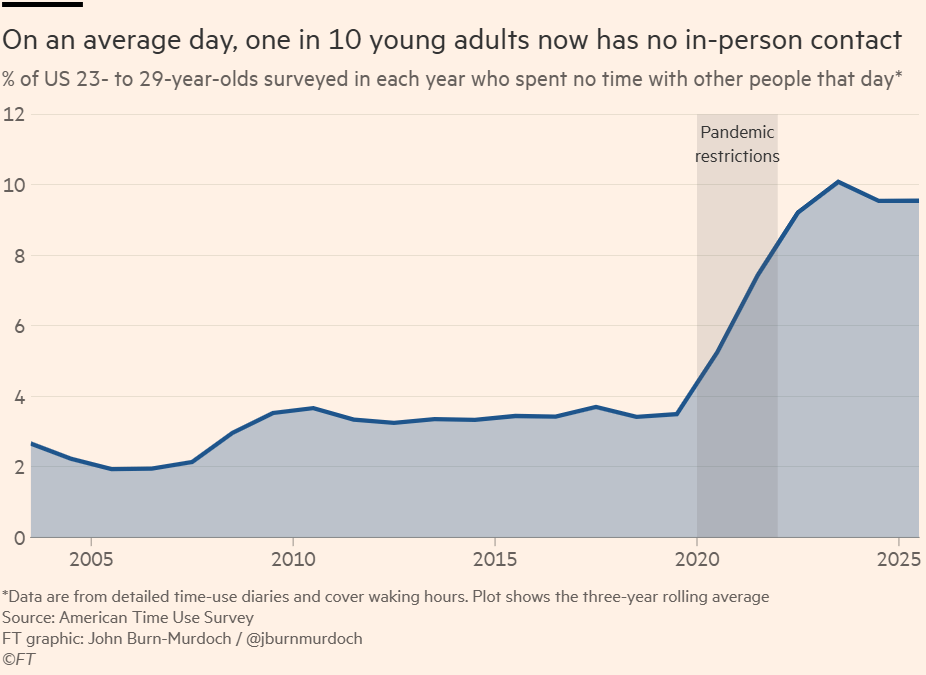
○ Are we cultivating a generation of hermits or a post-smalltalk digital utopia? John Burn-Murdoch considers the evidence.
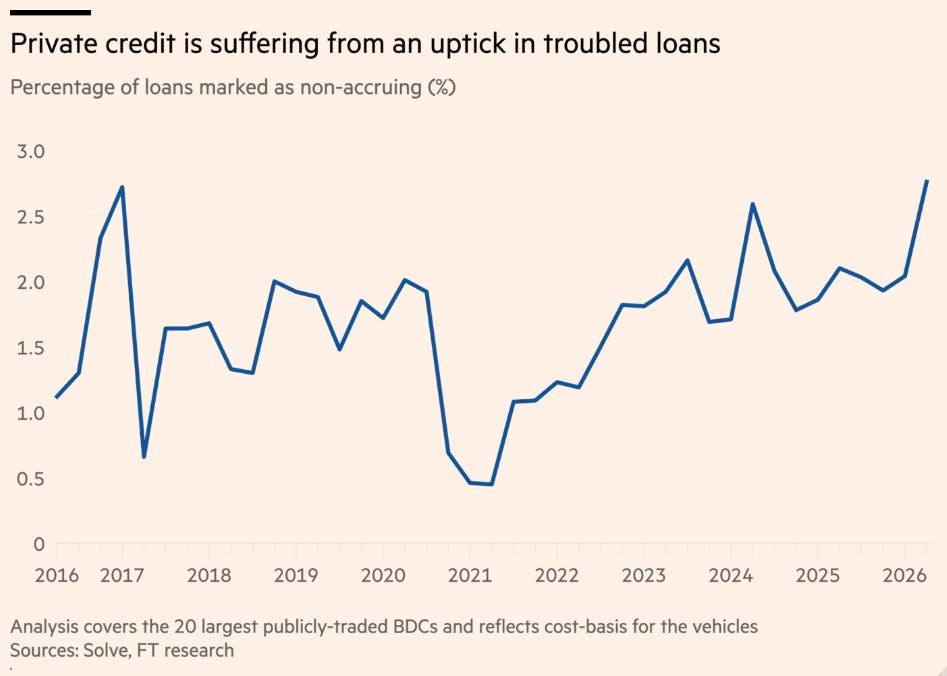
○ A turn in the cycle has taken the private credit market back to 2017 levels of stress.
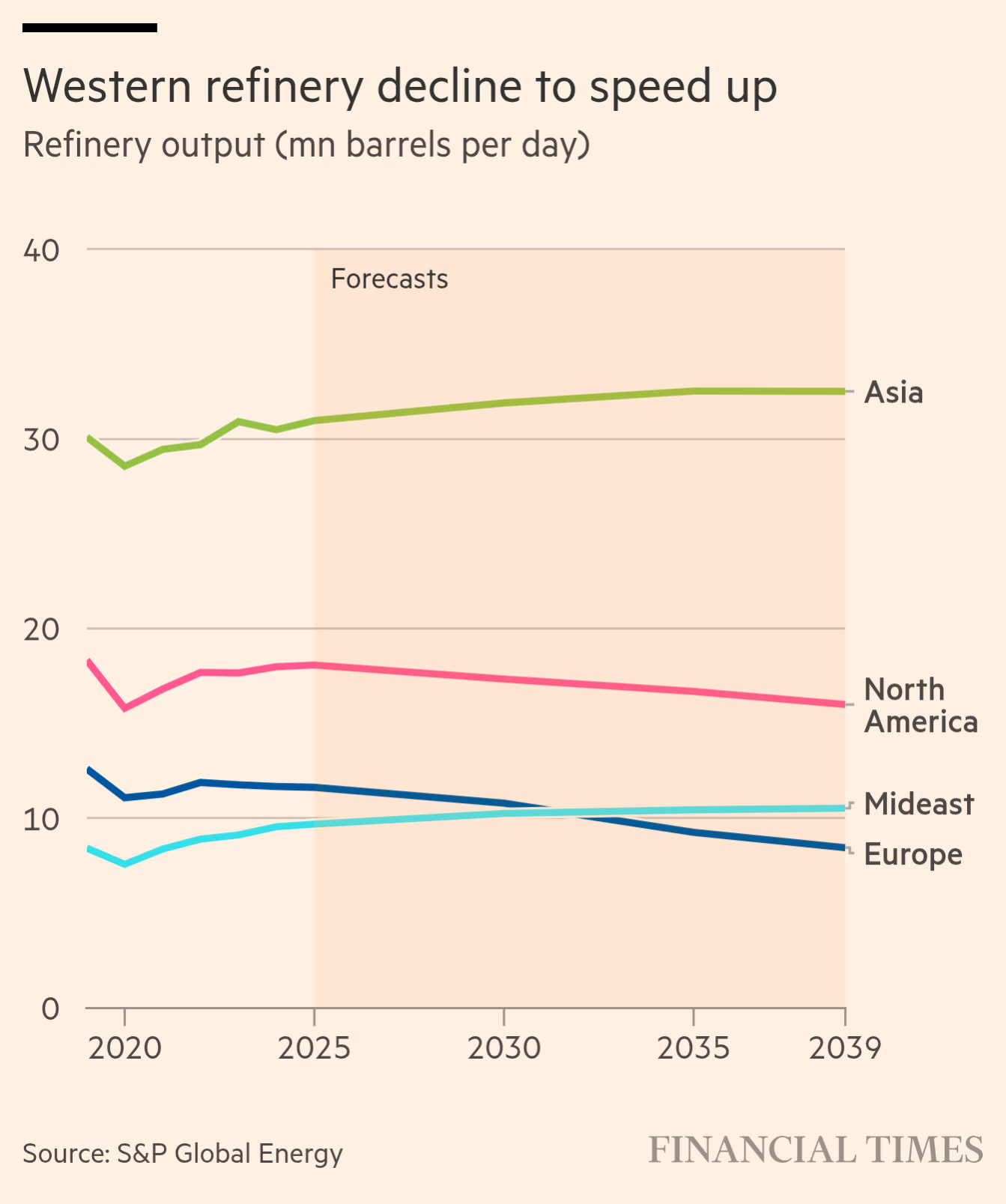
○ Oil refineries may be strategically important but for Europe, they're also very unattractive investments.
Real jab isn’t the “silicon god” framing, it’s the line about not being able to tell chatbot prose from founder prose anymore.
I use term “Cassandroid” for an AI that makes a correct prediction, then gets outcompeted by one which says whatever a company wants to hear— I’m idly posting that here on the off chance it then catches on