
Claude, make me rich
Also: American healthcare, Chinese patent squatting, Spanish immigration, a Japanese model city, and why you are not a horse

A favourite trope in the financial media is to get stock recommendations from people and things that have not shown a full understanding of the assignment’s complexities, such as cows, rats, astrologists, a yucca plant, and Neil Woodford.
The idea is to show that successful stock picking owes much more to dumb luck than skill. Comparing their results with professional investors is a cute way to demonstrate how persistent outperformance is rare and easiest to explain by survivorship bias. A professional’s other ways to win — such as having a non-public informational edge, or playing with a weight of capital that can move prices and buy favours — tend to be viewed by rivals and regulators as unfair advantages, so are rarely durable.
Asking an AI chatbot for stock recommendations is a recent variation of the trope. Bloomberg reports this week on Alpha Arena, a trading tournament that pits frontier large-language models against each other. Given two weeks to trade US tech stocks and $10k of punting money, they lost approximately a third of the total cash pile, with more than four-fifths of the LLM portfolios finishing in the red.
The LLMs “trade too much” and “make wildly different decisions when given identical instructions,” writes Justina Lee. Yes, that makes sense! Generative AI finds averages. Given the task of betting on stocks, they’ll synthesise the average meatbag market participant, who trades too much and will react in inconsistent ways to identical information. A chatbot has no edge, durable or otherwise, because the average investor has no edge.
Should anyone want such a thing, an LLM can also replicate the average response of a professional investor: that two weeks is a pointlessly short period to test any strategy; that different investment styles have myriad functions that won’t be captured by simple index comparisons; and that any discussion of active management also has to acknowledge that passive flows create systemic risks. How many times we need to hear these arguments is debatable. But, assuming a fund manager’s main function is to explain why they’ve lost money, a chatbot is certainly a more viable replacement than a cow.
Elsewhere, a paper from Goethe University in Frankfurt looks at the practicalities of seeking investment advice from AI. The researchers find that investors are significantly more likely to buy stocks when they use an LLM rather than a conventional search engine for research. This pattern, they say, can be explained by chatbots’ “effectiveness in confirmation-seeking”, where “users can prompt the model to validate beliefs they want to hold”.
Consumers may need to be protected from themselves, the researchers conclude, though with LLMs already widely adopted as an assistant to institutional decision-making, any trend towards confirmation-seeking may not be just a retail problem.
The vast majority of individual stocks lose money. The smartest trade is nearly always not to bother. But an entire industry is built on the idea that smart punters can beat the odds, and LLMs have been trained on all the bumf it produces. It would be unfortunate, but not altogether unexpected, if AI’s most visible effect in stock markets isn’t to democratise fundamental analysis but to individually reinforce the worst habits of the average.
A week on Alphaville
○ Do American healthcare costs drive global imbalances?
○ Alphabet, Microsoft and Amazon are booking a lot of income by marking up the valuations of OpenAI and Anthropic stakes.
○ Putting some numbers on SpaceX’s manufactured IPO demand from fast-track index inclusion.
○ After acquiring overseas, Chinese companies file a lot more patents.
○ GameStop is honestly very serious about wanting to buy eBay.
○ Here’s that huge and barely comprehensible Venn diagram you wanted of how the BDC ecosystem overlaps.
○ How resilient is the US to rising energy prices? Maybe less than it looks.
○ Binance founder Changpeng “CZ” Zhao has written an “awful” book.
○ Brad Setser and Stephen Paduano on why the US should refuse the UAE a dollar swap line.
○ Hungarian government-linked stocks had a good run, then didn’t.
○ The 13F form, by which US investment managers report their holdings, is less informative than it might look.
○ It’s tradition for bank research departments to publish research to preview the World Cup. Bank of America has done one of the oddest notes we’ve seen.
Best of Further Reading
○ Brian Albrecht of Economic Forces takes and runs with the old comparison between demand for horses in the early 1900s and how AI might change the modern workforce.
○ Capital Gains considers bubbles and how they pop.
○ Conversable Economist has a history of the disposable nappy.
○ Via Off the Charts, a brief history of charts named after people.
○ Grok was spoofed by a Morse code attack to send $200k in crypto to some random dude, reports Dexerto.
○ Ars Technica reports on Toyota’s $10bn private utopia.
○ Brace yourself for a century of cringe, from our friends at The Fence.
Chart Blast
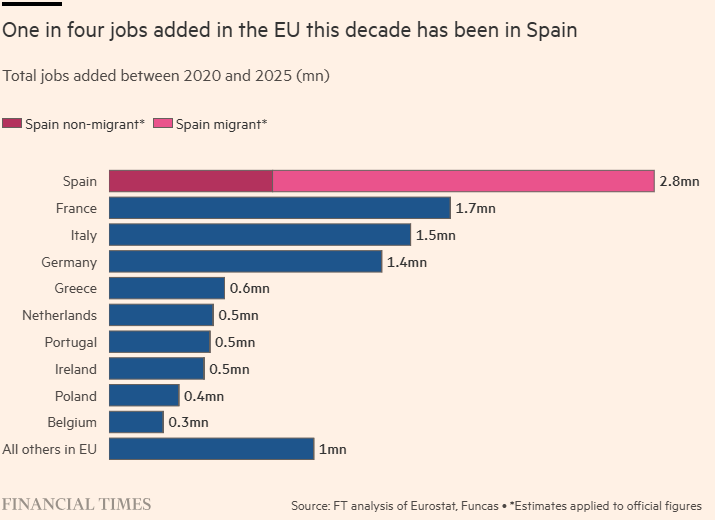
○ Spain’s been the world’s fastest-growing large advanced economy for the past two years, supported by an unusually open immigration policy.
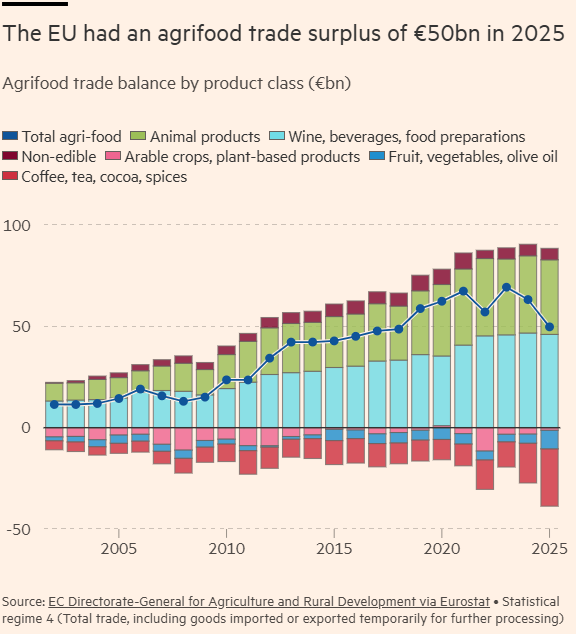
○ The future of subsidies that support EU food security while entrenching farmers’ outsized political influence is the subject of this big read.
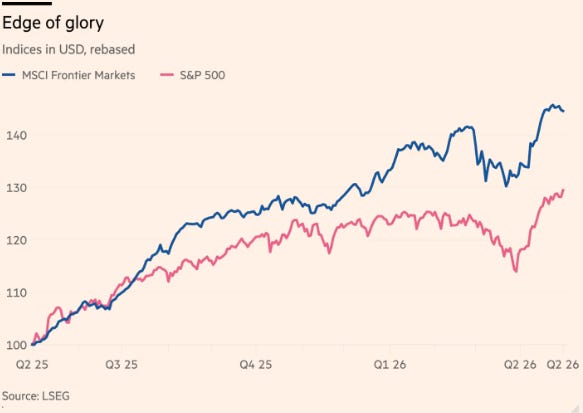
○ MSCI’s Frontier Markets index (30 per cent weighted to Vietnam, plus some Romania, Morocco, Kazakhstan and Slovenia) put in its best performance in almost two decades last month.
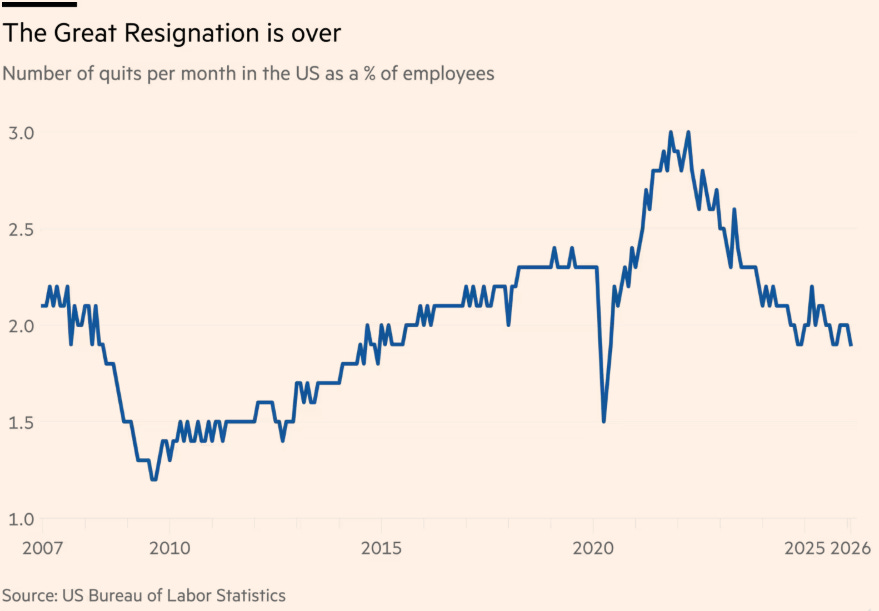
○ The post-COVID decline for the “Take This Job and Shove It” index speaks of vague uncertainty, as well as to the possibility that employees who changed their workday routines are now trapped by circumstance, writes Sarah O’Connor.
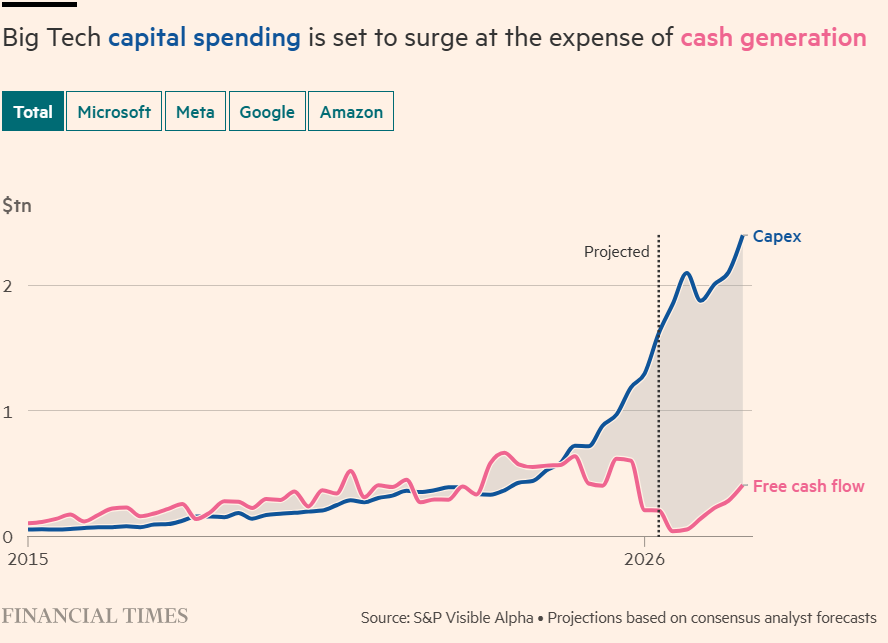
○ Cripes.
You had me at “and Neil Woodford”!
Cheers. Never fails to amaze me how many people take 13Fs at face value, especially not taking into account that the Fund may have a bunch of foreign holdings not listed.