
Big deal? Big deal
Also: AI hyperscalers, auditors, Jane Street, Anthropic, SpaceX, Situational Awareness, and out-of-office messages

Journalists like stories, and the stories they like most of all are their own. Anyone who’s been stuck making small talk with a reporter in a pub or at a party will know how ready we are to slip into autobiography. Our favourite subject is us.
Among the most susceptible to self-mythology are the merger-and-acquisition reporters.
It’s a weird job, to be fair. Deal reporters have to triangulate facts by talking all day to millionaires about transaction plans that can deliver only one person in the conversation a new yacht. Seeking to rationalise how they spend their lives, deal reporters might cast themselves as courageous truth-seekers, or as confidants to the rainmaker class, or as intermediaries between the financial gutter and the stars.
Whichever way, they’re going to tell you about it. Just try to stop them.
This week, the deal reporters have been everywhere. It kicked off because TD Securities made a league table that ranked them by accuracy, inaccurately. PR man Ed Hammond, an award-winning deals reporter when at the FT and Bloomberg, then wrote a bracingly honest explainer for Alphaville about how his stories came about.
David Carnevali, a current Bloomberg M&A reporter, responded on LinkedIn with a defence of his profession in the literary style of Molly Bloom's Soliloquy:
To have real flow means to have deep connectivity within the advisory and corporate ecosystems as well as keep planting seeds to gain more access. It means giving before taking and it entails going the extra mile to produce the best story when you land something worth writing about. […] When they are sitting across from you at the best table Casa Lever can offer, they are not thinking about the publication you work for. They are there for your brand, your platform and because they feel comfortable being around you. That’s when they might give you their best tip – not because they are leaking something at the expense of their client – but because they respect you and are willing to give you an opportunity to shine.
Great stuff!
As it happens, Alphaville has some history here. And since you’ve heard their stories, you’re going to hear ours. Settle in.
What we call deal reporting grew (not exclusively, but largely) out of the market report. This was a daily summary of what moved the day before on one local stock market, delivered by newspaper, which was a sort of disposable website sold through corner shops.
The idea of the market report was to explain why stocks had moved the way they did. A lot of the time, the information that moved stocks wasn’t public — a research note, a stake builder, a distressed seller, a bid rumour, whatever — so each market reporter had to cultivate their own gossip network of bankers, brokers, traders and PR people.
Relations were cordial. This being pre-internet, any information a source shared with a reporter was guaranteed not to appear in print until the next morning, so everyone knew exactly where they stood. And because there was never a shortage of dodgy types who tried to plant false or partial information in the media, the byline carried credibility. There were good and bad market reporters. Everyone in the trade knew which was which.
Gradually, then suddenly, it all changed. Newswire market reporting stepped up to offer more than just a chronology of prices. Newspaper owners and editors began to worry about the internet. Trader gossip networks grew bigger, having moved online, and no longer needed journalists for routine daily dissemination.
An accelerating flow of information made the old ways of reporting unsustainable. The banker and PR layers retained control by becoming more obstructive to the media, which was good for them but bad for us. That’s where Alphaville came in.
Circa 2006, in its first incarnation, Alphaville did market reporting by direct injection. We had all the best information, from contact networks built pre-internet by two of the best to play the game, and had full control of the delivery mechanism. The approach broke countless stories and pissed off a lot of rival media.
Our justification at the time was simple: M&A is too important a subject to keep quiet about. It’s important for customers, competitors, regulators and governments. It’s important to employees of the companies involved, many of whom will lose their jobs in pursuit of a synergy target. And it’s important to investors, who shouldn’t be selling at the wrong price to someone with inside information.
Our guiding principle was to assume that, if there was a deal rumour in circulation, it was already being traded on. Getting an accurate story out there as quickly as possible was helping to keep the market honest. Let sunlight be the disinfectant.
But Alphaville’s old contacts retired or drifted away, to be replaced by not-so-clubbable types who’d only communicate by encrypted messages on burner phones. These are the Mystery Men referred to in Ed’s post; people whose use for the media is solely transactional. Following one of their tip-offs could often feel less like letting in the sunlight, and more like laundering stolen material on their behalf. The game became a lot less fun.
Every story is different, however. That’s what it comes down to. Sometimes the story has been charmed out from across the best table Casa Lever can offer; other times, it has been planted by an operative for an organised crime syndicate. Should the average reader care either way? So long as the story’s true, it’s not obvious why they should.
The people who obsess about all this stuff, the mechanics of deal reporting, are the deal reporters. They’re the only ones who still notice the bylines. Being first with the scoop is a strange private competition, played between no more than a few dozen specialist reporters, that’s basically invisible to everyone outside their world. The job’s weird because it feels simultaneously important and irrelevant. The reason journalists talk about ourselves so much is that, if we didn’t, who would?
A week on Alphaville
○ The Treasury market’s toxic co-dependency with hedge funds.
○ Just how big is the hidden leverage of AI hyperscalers?
○ They’re in excess of $1.5tn, probably.
○ Jane Street is paying through the nose to flip $14.6bn of debt into secrecy-friendly bonds.
○ A look at the awful business of US non-bank mortgage lending.
○ Why it matters who audits Anthropic.
○ The curious case of the Japanese government bond yields.
○ Business development companies are paying more to borrow. But why?
○ The moony SpaceX sell-side research keeps on coming.
○ Chart crimes at the world’s biggest serviced-office provider.
○ We reiterate: Confessions of a former star M&A reporter.
○ What Australia can teach a new UK chancellor seeking a fresh approach to QE.
○ Breaking China’s dominance in rare earth minerals.
Best of Further Reading
○ Aswath Damodaran’s Musings on Markets surveys everything that went wrong at Situational Awareness.
○ From the Peterson Institute for International Economics, a big report on why US tariffs haven’t reduced America's dependence on Chinese goods and services.
○ Lauren Leek brings data to the discussion about why, from high streets to films and music, everything these days is so samey.
○ CringeBot 3000 is an AI LinkedIn post generator. Readers liked it. YMMV.
Charts, charts, charts
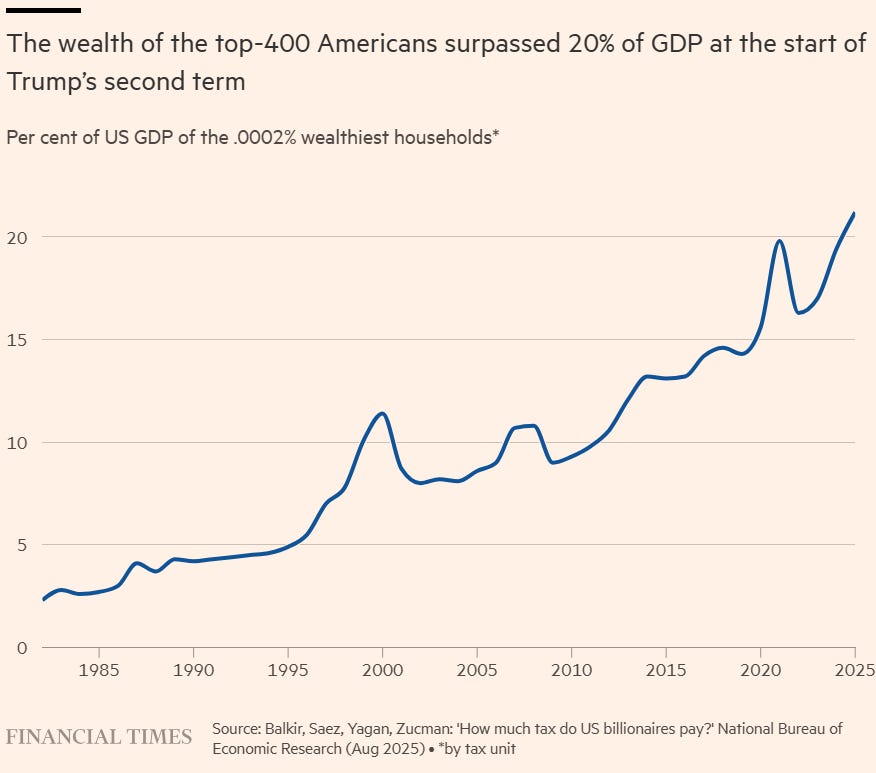
○ It’s been a good decade for America’s politically advantaged ultra-rich.
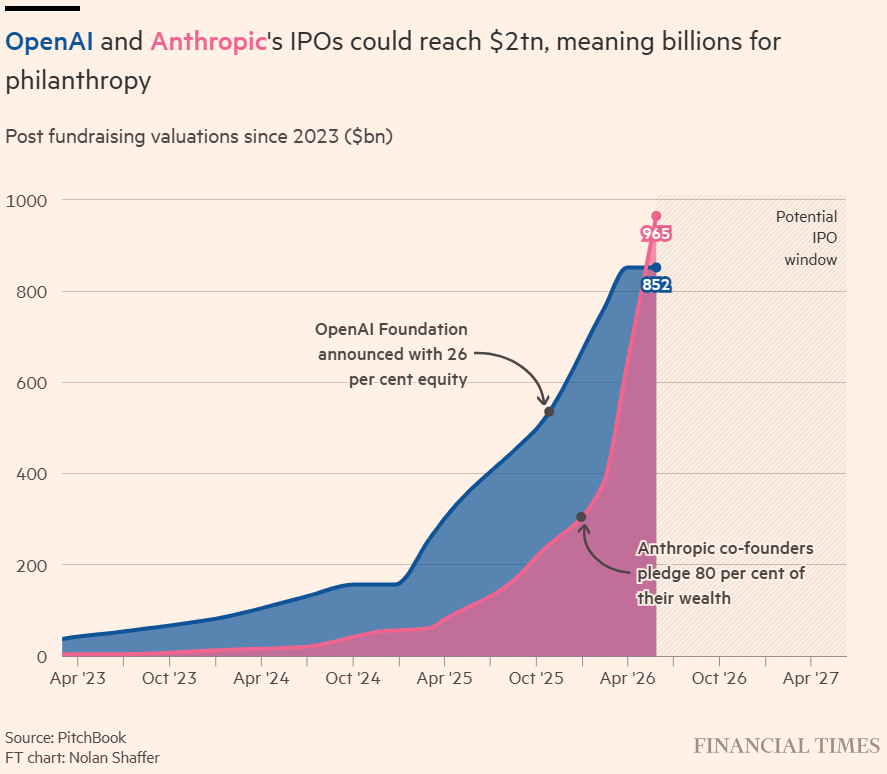
○ Effective altruism is back, and this time it’s powered by chatbots.
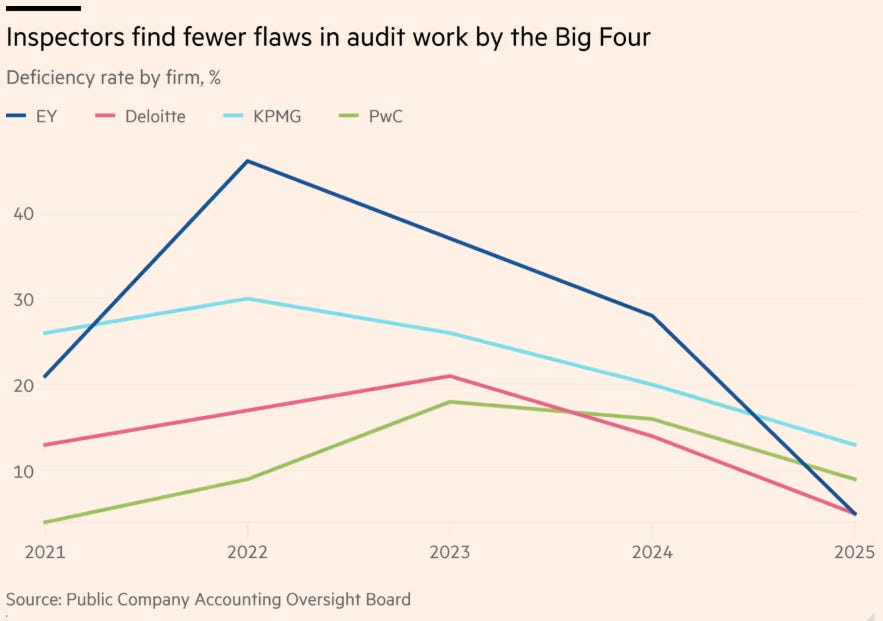
○ Audit deficiency rates are falling, possibly helped by post-Covid return-to-the-office policies.
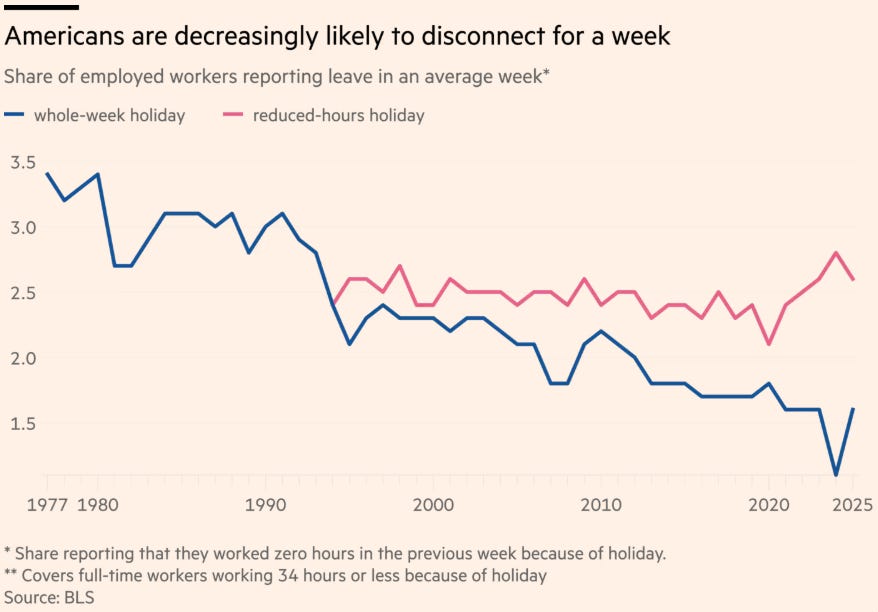
○ That’s from Soumaya Keynes’ rough guide to the out-of-office message.
“…delivered by newspaper, which was a sort of disposable website sold through corner shops.” Gold.
😊